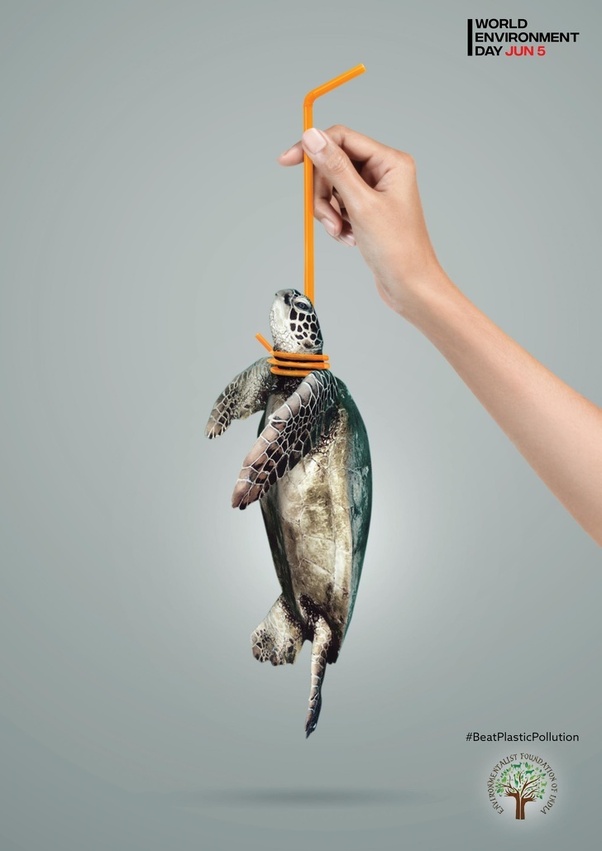
“What Are Some Really Creative Advertisements Which You like the Most?” Quora, Environmentalist Foundation of India.
https://www.quora.com/What-are-some-really-creative-advertisements-which-you-like-the-most.
Lately, advertisements have been bringing to our attention about how plastic items that us humans use are ending up in our oceans and killing innocent sea animals. Often these advertisements show their audiences an image of a sea animal suffocating from the plastic or inhaling the plastic. Adding a picture of a sea creature dying or suffering immediately should make the audience feel sympathetic especially with how graphic and real the image is. However, all around us we are surrounded by plastic and these advertisements often fail at what kind of action we can take to stop or how to dispose of the plastic use.
In the image provided, it shows us a young individuals hand holding a sea turtle with a plastic straw wrapped around its neck. The plastic straw is portraying a noose by the way it’s tied around the turtles’ neck. By having the plastic straw around the turtle’s neck, it shows the audience that plastic is to blame for the suffocating and killing of the creature. Using the plastic straw instead of any other type of plastic can be an example as one of the main plastic objects that’s planning on being banned. Plastic straws are one of the more popular items being used daily and being thrown away into the sea creatures’ homes. The background is a neutral color to bring focus to the suffocating of the turtle to make the audience feel sympathy and concern. Instead of using an ocean background it seems as if they wanted to focus the issue on the turtle and the usage of plastic only. At the bottom of the page, it provides us with a hashtag to follow on social media named #BeatPlasticPollution with the company’s logo right below it “Environmentalist Foundation of India”. In the top right-hand corner, it has “World Environment Day June 5” in black, red, and bold font to bring the attention to the audience to possibly participate. This type of image uses pathos because it can bring emotion to a possible animal lover or anyone who cares about the environment/future of the world.
By altering the image by adding some more details can make the advertisement become more effective and provide the audience with more information. Adding humans throwing their plastic in the trash and the trash suddenly falling in the ocean would be a great way of showing us where our trash ends up hours or days after. Showing more sea creatures in their home of an ocean suffering and being surrounded by plastic can express how it’s not only turtles who are being killed and what our trash, especially plastic, is affecting their lives and the cleanliness of the ocean. Adding a grey scenery around the animals can depict a dark and suffering environment for them which is exactly what is happening. Although the original AD gives us a hashtag to spread the movement of ending plastic pollution, the advertisement should have a solution on how to properly dispose of the plastic or substitutions we could use instead of plastic. Adding more logos of environmental companies or organizations can also help with making the advertisement more persuasive. At the end of the day viewers might look at the original image and ask the “so what” question. That’s why it’s important to show them how to change their ways to save the animals and the cleanliness of the ocean along with the facts of how plastic is negatively impacting the world.
Images that show a human holding the type of plastic as the murder weapon against humans only tells us that its us to blame for the deaths of the sea creatures and contamination of the sea. Although most of us humans do recycle and do our best to dispose of our trash properly. However, waste management companies are who we depend on to get rid of our trash in a safe and promising way. We hardly ever see advertisements of our waste management companies being to blame for the death of a sea creature. It is always a younger individual holding a turtle by a plastic straw tied around his neck. The audience can usually conclude that the individuals arm or hand in the advertisement is a young person because they have no wrinkles or age spots. This can also give away a message that the younger generation is to blame for which can be highly debatable.
Our society see’s so many ads for plastic use from companies that are supporting the ocean clean up but we hardly ever hear solutions that are being made to help the beautiful creatures of the ocean and the cleanliness of the ocean so we can capture fish for food that aren’t contaminated. Animals have no say in how our daily activities are affecting their futures. By properly spreading the word can make such a big difference. By adding facts of the amount of waste entering our oceans, how it’s affecting our food, and raising extinction levels can make a big difference in advertising. Some viewers can care less if there are no facts or actual images being shown so by adding of these sources it can be brought to everyone’s attention. With the power of social media in our society, we share what we think needs to be heard or what people are talking about with their family and friends. A video or picture can be shared across the world in just seconds. An advertisement that catches a viewer’s eyes can hopefully influence individuals to act upon the crisis or even volunteer to do ocean cleanups. Just a few changes for an advertisement and it might just bring more and more people together to make a change.
 The Adult Life No One Told Me About