“To find yourself, think for yourself”
– Socrates
“To find yourself, think for yourself”
– Socrates
For this blog I chose to do the Podcast called “Blame Game” by the Revisionist History.
This podcast was started off with the explanation of an incident a family went through while heading to a soccer game. As the family was driving the brakes of their Toyota failed to stop their moving car. Unfortunately the family was killed in the crash and the news quickly spreaded through the media. This news made another Toyota owners come forward with the same issue.
The power of the media and the power that an owners allegations can have towards a company/person is astounding. After all the allegations that Toyota was releasing cars that weren’t safe to drive, Toyota then had to pay a billion dollars in fines.
It’s almost scary how an allegation towards a company or a person can go to the next level of destroying a reputation. Even with the tests that they provided, many of the cars stopped when they applied the brake at full speed. The allegations that were against Toyota could all be either lying, tagging along to get compensation, or incorrectly driving their car.
The tests they provide show us that unless the drivers were going full speed and not pressing the brake all the way then Toyota has no fault whatsoever. The people who are driving the car should be able to perform the action of stopping the car when it’s moving at such a fast speed. The test they provide in the podcast show us how some drivers might actually be speeding up the car when they think they’re slowing down the car.
This also shows the power that a car can have over someone’s life. If you don’t know what you’re doing behind the wheel, the power the car can have can be powerful enough to take your life and whoever else is in the car or around you. The driver who was driving the Toyota that crashed is believed throughout the podcast that he was not familiar with the car and didn’t apply enough pressure to the brake OR had his foot on the wrong pedal.
The allegations of people who were experiencing brake failure could be lying to not face the fact that they actually do not know how to drive and would rather put the blame on the company just like other Toyota owners are doing. It’s a shame how money hungry people can be. They can become so money hungry enough to the point where they can care less of almost destroying a company’s reputation.
To solve the allegations of every Toyota owner that is accusing of Toyota of their car uncontrollably accelerating or their brakes failing, then the solution would be their driving has to be examined and how they handle a car in general or in an emergency.
For this podcast I chose the episode, “Food Fight”. During this episode it’s discussed how the quality of food your receive in college depends on if you’re rich or not.
Sadly not everyone can afford to attend a rich university like Bowdoin. If you can’t afford a fancy school then you’re treated like you’re nothing. If you go to Vassor then you can expect to get food that is served at prisons, maybe even worse from the sound of it. This goes to show that individuals with money have the power to get a better education, better treatment, possibly better jobs, and even better food. It doesn’t matter if you come from a poor family and are incredibly intelligent, you’ll be looked down upon from those on the high horse.
Students who attend Vassor can probably barley afford their schooling and living on campus. The tuition cost is ridiculously high to attend any college and yet they charge us thousands of dollars to pay them. It’s upsetting how students can pay such high amounts of money but receive food that is unappealing. I understand that the money is being used for more important things but I believe a diet is just as important as anything else.

The power money has in this world can either destroy you or get you to places others have to work 100 times harder to get to. Getting an education is what we believe will give us better a better life but a majority of students who attend college end up working a minimum wage job because of the amounts of money they had to put into trying to get a job.
While at Bowdoin the students are being treated like royalty AND getting a better education. However, it’s making it harder for leaders to help less fortunate individuals get into college.
The power of money and the power it can give someone is not only what people want but can still struggle even if they have enough or not enough of it.
For this blog I chose to do Episode 2, “The Lady Vanishes”. During the podcast the reader, Malcom, discusses how individuals can open the door for not only themselves but for others. Although sometimes those individuals close the door behind them and ruin the opportunity for everyone.
Elizabeth Thompson was criticized for winning her nomination to the academy in 1879. The thought of a woman being better than a man is exactly what was not acceptable in society. This shows how much power men can have over women. It didn’t matter if she was an amazing artist, her being a female was the only thing others were focused on. Women were looked upon to be mothers/wives at home and nothing else. Elizabeth’s husband never even wrote about her and it could be because men only wanted to be in charge and women were almost forced to keep their mouth shut. Even most husbands back then didn’t want their wives working or becoming more successful then them because that would be looked at as embarrassing and degrading.
This shows how men’s power in society, especially in politics, over women back then was incredibly strict. For Julia Gillard she struggled having people take her seriously and showing her respect. She was being sexualized in the media and laughed at to her face by many of those who were against a female being in office. This reminds me of how Hilary Clinton was close to being the first female president but even today a female president sounds absurd to men. Hilary Clinton also gave herself a bad image by getting involved in lies which gives men and even women the opportunity to be stereotypical. They can use Hilary as an example for why women shouldn’t be in office and can even shut the door for other opportunities for other females.
It’s a shame that amazing women like Elizabeth Thompson and Julia Gillard struggled to get noticed. My sympathy goes out to Elizabeth for giving up on her dream and letting men’s power tell her what she can and can’t do in life. Gillard also had to deal with such a disgusting response from the men who looked down on her.
Thankfully we see a lot of more women in higher positions in today’s society. However sexism is still common in our current time and although women try their best at standing up for themselves, men still have the mentality that they did decades ago. It’s questionable if women will ever hold the same power as men but we should be proud of how much more freedom and power we’ve gained since the 1800’s. No matter what, females will continue to make even more history then we already have.

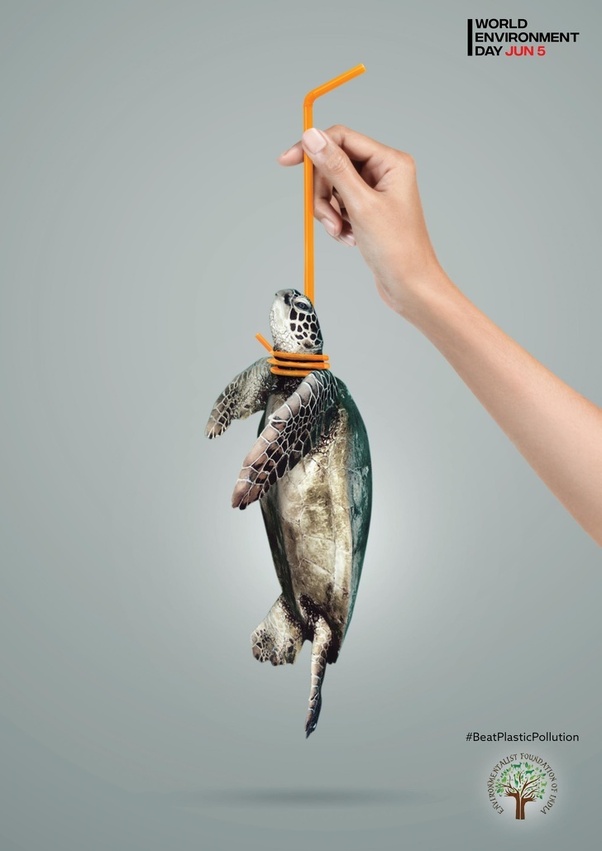
Lately, advertisements have been bringing to our attention about how plastic items that us humans use are ending up in our oceans and killing innocent sea animals. Often these advertisements show their audiences an image of a sea animal suffocating from the plastic or inhaling the plastic. Adding a picture of a sea creature dying or suffering immediately should make the audience feel sympathetic especially with how graphic and real the image is. However, all around us we are surrounded by plastic and these advertisements often fail at what kind of action we can take to stop or how to dispose of the plastic use.
In the image provided, it shows us a young individuals hand holding a sea turtle with a plastic straw wrapped around its neck. The plastic straw is portraying a noose by the way it’s tied around the turtles’ neck. By having the plastic straw around the turtle’s neck, it shows the audience that plastic is to blame for the suffocating and killing of the creature. Using the plastic straw instead of any other type of plastic can be an example as one of the main plastic objects that’s planning on being banned. Plastic straws are one of the more popular items being used daily and being thrown away into the sea creatures’ homes. The background is a neutral color to bring focus to the suffocating of the turtle to make the audience feel sympathy and concern. Instead of using an ocean background it seems as if they wanted to focus the issue on the turtle and the usage of plastic only. At the bottom of the page, it provides us with a hashtag to follow on social media named #BeatPlasticPollution with the company’s logo right below it “Environmentalist Foundation of India”. In the top right-hand corner, it has “World Environment Day June 5” in black, red, and bold font to bring the attention to the audience to possibly participate. This type of image uses pathos because it can bring emotion to a possible animal lover or anyone who cares about the environment/future of the world.
By altering the image by adding some more details can make the advertisement become more effective and provide the audience with more information. Adding humans throwing their plastic in the trash and the trash suddenly falling in the ocean would be a great way of showing us where our trash ends up hours or days after. Showing more sea creatures in their home of an ocean suffering and being surrounded by plastic can express how it’s not only turtles who are being killed and what our trash, especially plastic, is affecting their lives and the cleanliness of the ocean. Adding a grey scenery around the animals can depict a dark and suffering environment for them which is exactly what is happening. Although the original AD gives us a hashtag to spread the movement of ending plastic pollution, the advertisement should have a solution on how to properly dispose of the plastic or substitutions we could use instead of plastic. Adding more logos of environmental companies or organizations can also help with making the advertisement more persuasive. At the end of the day viewers might look at the original image and ask the “so what” question. That’s why it’s important to show them how to change their ways to save the animals and the cleanliness of the ocean along with the facts of how plastic is negatively impacting the world.
Images that show a human holding the type of plastic as the murder weapon against humans only tells us that its us to blame for the deaths of the sea creatures and contamination of the sea. Although most of us humans do recycle and do our best to dispose of our trash properly. However, waste management companies are who we depend on to get rid of our trash in a safe and promising way. We hardly ever see advertisements of our waste management companies being to blame for the death of a sea creature. It is always a younger individual holding a turtle by a plastic straw tied around his neck. The audience can usually conclude that the individuals arm or hand in the advertisement is a young person because they have no wrinkles or age spots. This can also give away a message that the younger generation is to blame for which can be highly debatable.
Our society see’s so many ads for plastic use from companies that are supporting the ocean clean up but we hardly ever hear solutions that are being made to help the beautiful creatures of the ocean and the cleanliness of the ocean so we can capture fish for food that aren’t contaminated. Animals have no say in how our daily activities are affecting their futures. By properly spreading the word can make such a big difference. By adding facts of the amount of waste entering our oceans, how it’s affecting our food, and raising extinction levels can make a big difference in advertising. Some viewers can care less if there are no facts or actual images being shown so by adding of these sources it can be brought to everyone’s attention. With the power of social media in our society, we share what we think needs to be heard or what people are talking about with their family and friends. A video or picture can be shared across the world in just seconds. An advertisement that catches a viewer’s eyes can hopefully influence individuals to act upon the crisis or even volunteer to do ocean cleanups. Just a few changes for an advertisement and it might just bring more and more people together to make a change.
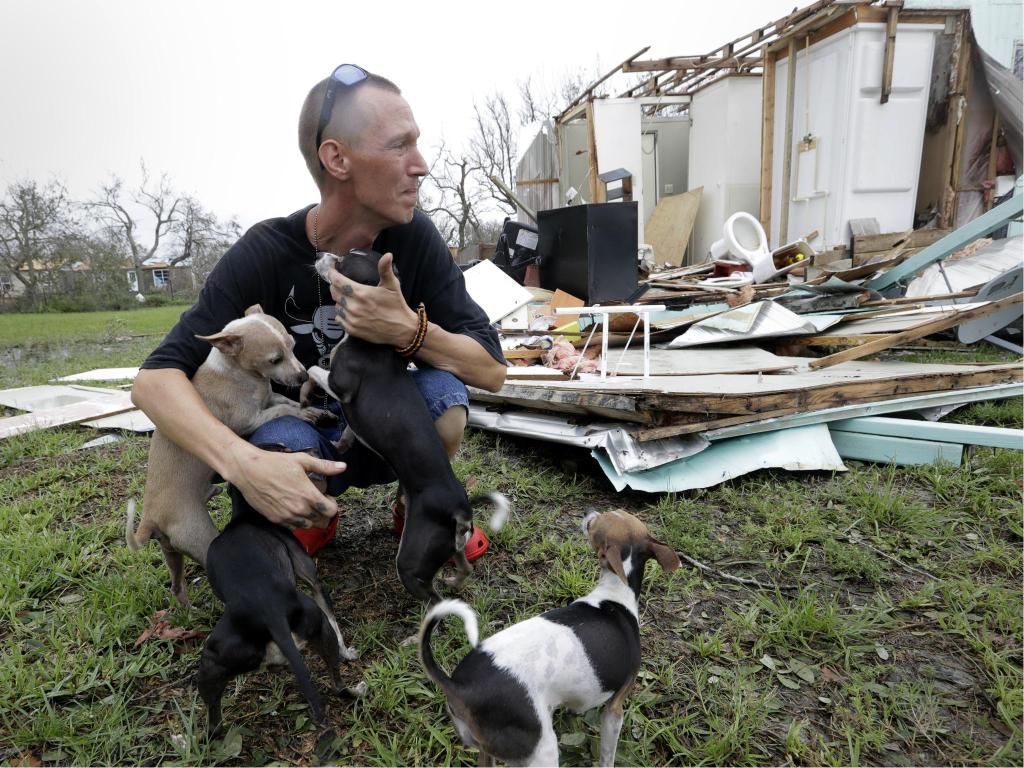
1.) The photographer of this photo is named Eric Gay and published on the website Independent Website. The photographer Eric Gay, didn’t have any articles about this exact picture but when you search his name he has a history of taking pictures of natural disasters. The publisher or photographer do not play a role in the image but the website does notify everyone in the U.S of exactly what was going on during Hurricane Harvey.
2.) The intended message behind this picture is to show the devastation that the survivors of natural disasters go through. Although not everyone lives in areas where natural disasters happen, it’s important to show them that it can happen to anyone and how we can help them as much as possible. It can also be intended to not leave your animals behind because they’re not able to help themselves and depend on their owners to get them out of the natural disasters.
3.) The message/image is not persuasive. This image shows the reality of survivors including the man in the picture named Sam Speights. Although Speights leaves no quote in the article where his picture is posted on Independent Website, his image says enough.
4.) The intended audience for this image is worldwide. Across the world, natural disasters happen and it can express to others that they’re not alone in these situations where your home is taken away from you in just a few minutes. It can also make people from around the world get together to help those in need that are found in helpless situations like the one in the image above.
5.) In this image by Eric Gay, He captures Speights home in the background absolutely destroyed. It takes place after Hurricane Harvey does it’s destruction and not to long ago due to the emotional hurt Speight is in. Speight could be thinking about where he and his animals are going to sleep or how they’re going to eat since his body language comes off as concerned, worried, and comforting while trying to hold back tears. Overall, the image can be delivered as capturing a survivor in a devastating time in his life.
Semiotic Elements
Symbolic: A man with nothing in his hands but his four small and helpless dogs is the main subject of the photo. The cloudy and destroyed background is to express the loss and grief that the man is going through. The animals in the picture seem to be looking at their owner in hope of direction and comfort. No other humans are around him which could symbolize the type of loneliness the survivor is feeling. The body language of him comforting his animals and looking to the far distance symbolizes his hope for help.
Written: The caption of the article reads: ‘Unprecedented’ Houston flooding to leave 30,000 people homeless. The bold font of the article show the readers that it’s a serious topic. The choice of words to use homelessness is a reality that many survivors are going to have to face because of the natural disasters. The article brings awareness to the homeless rate rising after Hurricane Harvey, the effect/damage it had on Texas, and the outcome of what had happened so far after the hurricane hit. This article was written by Mythili Sampathkumar.
If you grew up with watching television or roaming the internet, then you’re probably familiar with seeing the examples that the text provides us. It’s almost normal to us to see such a handsome man advertising tools or a new vehicle and an attractive young woman advertising a new beauty product. When it comes to food, we often stereotype on what a certain gender eats on the daily. With all the criticism and hate, we are often told to look a certain way, eat certain foods, or act a certain way.
This text is great at bringing attention to the type of stereotypes and objectification the entertainment and food industry shows to get money in their pockets. It helps the audience see that these type of objectifications isn’t and should never be okay to anyone. It’s also important for everyone in today’s society to learn from the mistakes others made in the past and how to make a difference.
If a man has a healthier diet than eating out from fast food everyday, he’s looked upon as feminine. It’s odd that these stereotypes are normalized. If we expect a man to only eat a “manly” and unhealthy diet, then realistically they’re going to become overweight and a man being overweight is also stereotyped to them being lazy or unattractive.
In the passage they give us examples of fast food commercial’s that are full of objectification’s of women and men. Nodaway’s our society is trying to use less stereotypes and objectifications as entertainment and more equality. Instead of using just a lady in “sexy” clothing, we have commercials that now use humor of relatable jokes in our daily lives.
Overall, it’s complicated trying to meet everyone’s expectations which is why we shouldn’t always give in to the criticism and hate. What we eat or want to look like is our own business. Hopefully the stereotypical and objectifying commercials/advertisements can come to an end.
In Chapter Eight, Graff and Birkenstein bring to our attention how writers sometimes struggle with making sure that they’re sentences connect with each other. In this chapter they teach us how to connect our writing with our sentences and make sure that it can flow smoothly. Certain phrases can make our sentences confusing or make our sentences sound choppy which is what no writer wants. Transitions is one of the main lessons were taught in able to help us with out writing and overall making our writing readable.
Personally, I tend to struggle with making my writing flow and making sure that my sentences connect with one another. When I think that my writing is going well and I would submit it, I remember seeing all the corrections I had to fix. Hopefully with the continuous reading of this book I can become a better writer after every chapter.
In Chapter Nine it’s brought to our attention how us writers tend to use a different voice when writing. Graff and Birkenstein teach us that it’s okay to use our everyday voice. Although, the voice we have with our friends is advised not to be put on paper. It is recommended that we have others critique our writing so that we can learn where our strengths/weaknesses are and can later improve.
While reading about the language we should be using in our writing, I find myself guilty with using a voice that I use in my writing that is different from my everyday voice. It would probably help if I make sure I sound like myself in my writing as well.
Throughout Chapter Ten, The readers are taught about Metacommentary. Graff and Birkenstein want to assure their readers to use certain phrases to avoid confusion and paragraphs of explaining about what one sentence meant. The templates in this chapter also explain to us the different ways to introduce metacommentary to our readers.
Before this chapter I’ve never heard of metacommentary. This was an interesting chapter to read because I was able to learn the definition of metacommentary and how to properly phrase my paragraphs in able to avoid complicating metacommentary.
In Chapter Eleven, Graff and Birkenstein teach us that it’s important to revise our writing. Often we hate having our writing criticized or having to criticize someone else’s writing but it can teach us how to improve our own writing and how to look out for the mistakes in others work. We are then shown templates on how to revise our writing or others.
I do enjoy having my writing critiqued so that I can learn from my mistakes and knowing what to avoid in the future. Being able to follow along with a revised text of Family Guy helped a lot. It also showed me on what to look out for and the type of revising that can help me critique others or my own writing.
In an article by Virginia Heffernan, she makes an argument about how headphones are the reason for individuals losing their hearing, especially teenagers. Throughout the article she discusses what the main purpose of what headphones were created for and what we use them for today. Heffernan also discusses the way that we use them today and how it’s dangerous for the future of our hearing throughout her article.
Heffernan addresses adults/parents as her audience because throughout the article she talks to an audience to make them aware of what teens are doing to themselves with headphones. At the end of the article she tells parents that they should not only monitor their kids with the usage of their headphones but also to monitor what they’re listening to because she states that it makes teens antisocial.
Since the main argument is about headphones ruining an individuals hearing, Heffernan gives claims throughout the passage to back up her argument. One of the main claims she gives us is a growing percentage of the amount of teens going deaf since 1994 from a study by The Journal of the American Medical Association. Suddenly, Heffernan begins to shift her topic of teens losing their hearing due to headphones to teens escaping reality with the help of headphones in the second to last paragraph before the end of her article.
Although in part of the article she explains how headphones can be beneficial in our lives, she bases the argument off of the negative side of headphones. Right under her second paragraph, Heffernan makes a statement that shows us that she is going to be talking about the downside of headphones. She tells her audience how the danger of digital culture is not how teens have the attention span of hummingbirds but that they are going deaf.
In Chapter 4 of They Say, I Say, Graff and Birkenstein teach us how to respond to a writers view point in a respectful and proper way. Most of us tend to struggle with how to respond to work of a writer especially when we feel we don’t know enough about it. Graff and Birkenstein assure us that ” What these students come to realize is that good arguments are based not on knowledge that only a special class of experts has access to, but on everyday habits of mind that can be isolated, identified, and used by almost anyone.” This quote from the passage explains to us that by simply living our own life, we have enough content to create for our own writing and responses. From disagreeing or agreeing with a writers work, Graff and Birkenstein show us how to correctly do just that.
Before reading this chapter I was not aware of all the different type of templates that you could use to respond to a writer. The main thing that might be a struggle for me still is not making my readers confused when I am undecided with an opinion. Graff and Birkenstein discuss it in the text but I feel as if it might be a little more complicated when you’re having to actually go through it.
During Chapter 5, we are shown how to make a clear view on whose voice is being expressed in our writing. To avoid confusion to our audience, we are taught what to do and what not to do. This chapter also shows us how to use different templates to start our writing. The common phrase we have all heard is not to use ‘I’, so Graff and Birkenstein explain to us that sometimes it is okay to use it or other substitutes for “I” in our writing. It is expressed to make our writing clear enough on who is saying what and how not to confuse our reader.
For this chapter I learned different ways on how to make sure our voice or another writers voice is heard correctly. I didn’t realize how confusing it could be to our readers when we word our sentences a certain way. The templates in each chapter are going to come in handy whenever we have a paper to write in class
In Chapter 6, Graff and Birkenstein explain to us how to take criticism of our writing as a useful tool. It is important to be able to hear someone else’s criticism and use it to improve our writing and not let it doubt our talent. Criticism can also come along even when we edit our writing hundreds of times to make it as perfect as possible. We need to be able to confidently take that criticism and know that what we wrote is good enough. In some aspects, we can use the criticism we know were going to receive in our paragraphs. Graff and Birkenstein show us many examples on how to word our sentences the correct way to address our readers concern/criticism.
During this chapter I wasn’t aware of how useful it would be to address our audience’s concerns in our writing. It will definitely come in handy when writing my future essays. I actually really enjoyed reading all the advice that Graff and Birkenstein give to their readers.
Chapter 7 shows us how to properly get our point across in our writing. We don’t want our readers to read our work and question what in the world we were even talking about. On top of that we don’t want them to say “who cares”. In the templates given to us it allows us to show our readers why they should care and how we can bring our point across as clear as possible. It’s important to get our readers to care about what we are writing about and make them read without falling asleep.
In this chapter I found the advice of how to NOT keep our readers confused and bored very helpful. I personally sometimes struggle with getting my writing to flow with each sentence. It’s something I work on with each writing assignment and hope to really grab my readers attentions with the advice given from Graff and Birkenstein.
We often hear real life stories of victims who were injured or sometimes murdered on many media platforms. After hearing about the sad and heart breaking news, one of the main questions we ask is if the person who did the crime was found. Unfortunately, sometimes the person that is accused of doing the crime can’t be held accountable because of the evidence used against them or no evidence is found at all.

If you are a big fan of documentaries on true crime then you’ll know exactly how frustrating it is when you watch a guilty person getting away. Following a story from the very beginning can make you feel like you’re a detective yourself. Listening to all of the stories from the witnesses or seeing the clues that leads up to the final trial can make you positive that a certain someone is guilty of the crime. Although were confident that the person is guilty, not having enough evidence could let them walk free which is justifiable but also a frustrating action.
In the text of “Evidence”, the writers express how over time the court system has changed which I believe is for the better. By not allowing just anyone to accuse an innnocent person, it has saved many lives from being taken away and locked inside a cell.

In today’s time, we still struggle with finding enough evidence to lock up an actual criminal. With how much technology has grown we have been able to go far and beyond to find evidence. Unfortunately, criminals are more familiar with the routine that detectives go through now which makes it easier for them to cover up their tracks. This makes it harder for the justice system to prove someone guilty.
There are different types of evidence that is searched for during a criminal case. If no evidence can be backed up with facts, then a criminal is free to go. Often after years go by, more evidence comes around and it can be enough to get that person back into jail or someone out of jail. On the other hand, I’ve heard stories of cops actually placing evidence on an innocent persons property to cover up for someone. It’s usually rare but having an innocent person that is being framed does happen.
As years go by, our justice system grows bigger and better everyday. It won’t be long until we compare today with the future like “Evidence” did with the witch trials. More criminals will be stopped and hopefully evidence will be easier to find. It is important to make sure that whoever is being charged with a crime is actually guilty, too many innocent lives are being taken away due to false evidence or because they’re being framed for a crime they didn’t do.

 The Adult Life No One Told Me About